
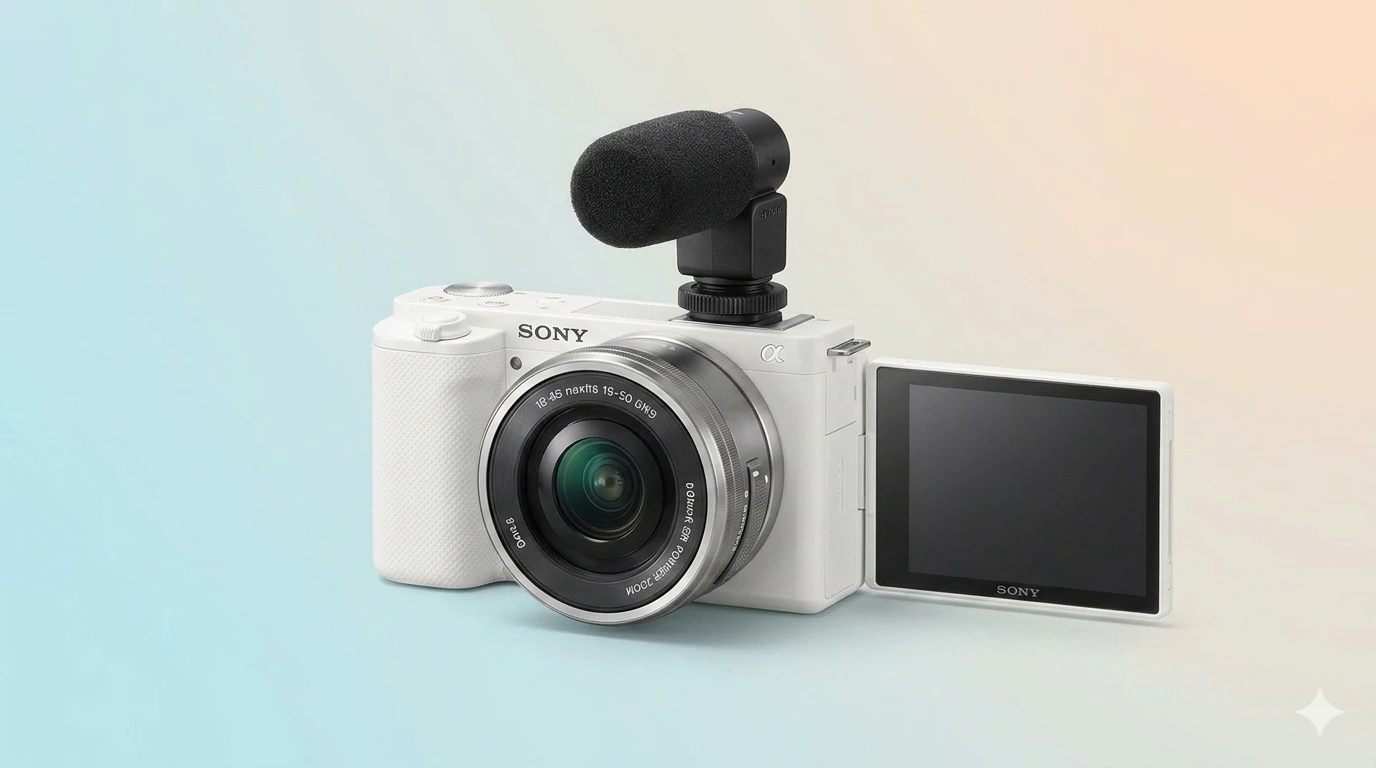
This post contains Amazon affiliate links. We may earn a small commission if you buy through our links — at no extra cost to you.
The Sony ZV-E10 II is the best vlogging camera Sony has ever made under $1,000.
It carries the same 26MP sensor as the $1,400 Sony a6700. It shoots 4K at 60fps with 10-bit color. It packs 759 autofocus points with real-time eye tracking. Furthermore, its battery lasts up to 195 minutes of continuous recording — a huge upgrade over the original ZV-E10.
But does the Sony ZV-E10 II deserve the title of best YouTube camera in 2026? And is it worth the $300 price increase over the first model?
We answer both questions below — with honest real-world results.
Quick Verdict
The Sony ZV-E10 II is an outstanding camera for desk-based and studio vloggers. It shoots flagship-quality video, tracks subjects with impressive accuracy, and handles long recording sessions well.
However, it is not perfect. It has no in-body image stabilization (IBIS). As a result, handheld walking shots need a gimbal or stabilized lens. Also, the price jump to $999 body-only is significant for first-time buyers.
Best for: YouTube creators, studio vloggers, talking-head content, podcasters, and anyone stepping up from a smartphone.
Not ideal for: Walkaround street vloggers who need IBIS. Still photographers. Buyers on a budget under $700.

- Exmor R CMOS sensor: The ZV-E10 II features Sony’s most advanced sensor technology in an APS-C back-illuminated Exmor R …
- Interchangeable lenses to capture your vision : From the G Master series, which blends breathtaking resolution with exqu…
- Create your look in camera: The Creative Look function makes it simple to create expressive moods for stills and movies …
Key Specs at a Glance
| Spec | Sony ZV-E10 II |
|---|---|
| Sensor | 26MP APS-C BSI Exmor R CMOS |
| Processor | BIONZ XR |
| Max video | 4K/60fps, 10-bit 4:2:2 |
| Slow motion | 1080p/120fps |
| Autofocus points | 759 phase-detection |
| Subject tracking | Real-time Eye AF (human and animal) |
| Stabilization | Digital Active Mode (no IBIS) |
| ISO range | 100–32,000 (expanded to 102,400) |
| Continuous shooting | 11fps |
| Battery | NP-FZ100 — up to 195 min recording |
| Screen | 2.95″ fully articulating touchscreen |
| Microphone input | 3.5mm |
| Headphone output | 3.5mm |
| USB-C | Livestreaming + clean HDMI out |
| Wi-Fi | 5GHz + Bluetooth |
| Lens mount | Sony E-mount |
| Dimensions | 121 × 68 × 54mm |
| Weight | 377g (with battery and card) |
| Price (body only) | ~$999 |
| Price (with kit lens) | ~$1,099 |
⚠️ Prices verified on Amazon — May 2026. Click through to confirm the latest deal before buying.
Design and Build: Compact, Creator-Focused, and Practical
The Sony ZV-E10 II is a small camera. It measures just 121 × 68 × 54mm and weighs 377 grams with the battery and card inside. So it fits easily in a backpack or shoulder bag.
The body is mostly plastic. However, the build quality feels solid and reliable. Nothing flexes or rattles. It feels like a camera built for daily use rather than occasional weekend shoots.
The Fully Articulating Touchscreen
The rear screen is a 2.95-inch fully articulating touchscreen. It flips out completely to face forward. As a result, you can see yourself clearly while filming — essential for solo vlogging.
It also rotates 270 degrees. In addition, the touchscreen lets you tap to change focus during recording. For solo creators, this is one of the most practical screens on any camera at this price.
Vlogger-Specific Features Built In
Sony includes several features designed specifically for creators. The Background Defocus button creates shallow depth of field instantly — no menu navigation required. Also, the Product Showcase setting lets the camera quickly shift focus to an object you hold up, then returns to your face. Both features save significant time during a shoot.
There is also a Soft Skin Effect mode for flattering portrait video. Furthermore, a Cinematic Vlog Setting applies pre-baked “Looks” like S-Cinetone and colour “Moods” directly to your footage. So you can achieve a cinematic look without any colour grading in post.
Video Quality: Genuinely Flagship-Grade
This is where the Sony ZV-E10 II earns its price. The video specs are seriously impressive for the size and price.
4K 60fps with 10-Bit Colour — A Massive Upgrade
The original ZV-E10 shot 4K at only 30fps in 8-bit. The ZV-E10 II jumps to 4K at 60fps in 10-bit 4:2:2. That is a massive leap in both motion clarity and colour depth.
10-bit colour dramatically expands the dynamic range and grading flexibility. As a result, your footage holds far more detail in highlights and shadows. In post-production, you have much more flexibility to adjust exposure and colour without damaging the image.
Also, 4K/60fps allows smooth slow-motion playback at 2× speed in a 30fps timeline. For beauty, cooking, and lifestyle content, this creates a noticeably more cinematic feel.
Oversampled 4K — Better Detail Than Most Rivals
The ZV-E10 II uses an oversampled 4K mode. It reads more sensor data than it needs and downsamples to 4K. As a result, the final image is cleaner and sharper than cameras that use pixel binning.
The oversampled 4K mode provides a good level of detail, especially compared to subsampled video modes on cameras like the Fujifilm X-T50. The difference is visible on a large monitor or TV — edges are crisper and fine textures like fabric and hair look more resolved.
Cinematic Mode for Direct Publishing
The ZV-E10 II also includes a Cinematic Vlog mode. It shoots at 24fps with a 2.35:1 widescreen aspect ratio and pre-applied black bars. This produces a theatrical look directly from the camera. So you can publish straight to YouTube without any editing for creators who prefer a cinematic style.
Rolling Shutter — An Honest Assessment
The ZV-E10 II uses a faster sensor than the original ZV-E10. The original exhibited a lot of rolling shutter in 4K/24 mode and had to crop to deliver 4K/30. The new camera shoots 4K/60 using most of the sensor, meaning it is over twice as quick at reading the sensor.
In practice, rolling shutter is well-controlled in 4K/24p and 4K/30p. However, fast panning at 4K/60p can still show some wobble. For desk and studio vloggers, this is not a problem. For fast-motion sports or run-and-gun content, it is worth knowing.
Autofocus: One of the Best in Its Class
The 759-point phase-detection autofocus system is one of the strongest features of the ZV-E10 II.
Real-Time Eye AF — Fast, Accurate, and Reliable
The ZV-E10 II uses Sony’s Real-Time Eye AF for both humans and animals. In real-world vlogging use, the camera locks onto your eyes almost instantly. It also holds focus reliably through head turns, hands crossing the face, and movement.
The 759-point AF system is one of the strongest features highlighted in every major review. Furthermore, the BIONZ XR processor handles the tracking computation fast enough that focus never visibly hunts during normal vlogging scenarios.
For YouTube creators filming themselves, this is the most important autofocus requirement. And the ZV-E10 II passes that test confidently.
Animal Eye AF — Useful for Pet and Wildlife Content
Animal Eye AF also works reliably. So pet vloggers, nature creators, and animal content channels will find the autofocus covers their specific content type equally well.
The No-IBIS Limitation: The Biggest Thing to Know
This is the most important caveat in this entire review. The Sony ZV-E10 II has no in-body image stabilization (IBIS).
What This Means in Practice
The ZV-E10 II includes digital Active Mode stabilization. It uses a gyroscope and software to reduce shake. However, it applies a 1.33x crop to your footage when activated. So your field of view narrows every time you enable it.
In a desk or studio setup — where the camera sits on a tripod — the lack of IBIS is completely irrelevant. However, for walkaround street vlogs or run-and-gun content, the footage will look shaky without a gimbal or a lens with optical stabilization.
The honest take from experienced reviewers is direct: the ZV-E10 II is a stationary YouTube camera. It is probably the best stationary YouTube camera at this price. For in-motion vlogging content, tools like the DJI Pocket 3 with a built-in gimbal are a better choice.
The Solution: Use a Gimbal or Stabilized Lens
If you want to shoot while walking, there are two good solutions. First, pair the ZV-E10 II with a gimbal like the DJI RS 3 Mini (~$200). Second, use a lens with built-in optical stabilization — like the Sony 10-20mm f/4 PZ, which is specifically designed for the E-mount APS-C system.
Either approach gives you smooth footage. However, both add cost and setup time.
Battery Life: A Huge Improvement Over the Original
Battery life was the number one complaint about the original ZV-E10. Sony addressed it directly with the ZV-E10 II.
The ZV-E10 II uses the NP-FZ100 battery — the same larger battery used in Sony’s professional Alpha cameras. Sony claims up to 195 minutes of continuous recording. In real-world testing, most creators achieve 150–180 minutes before needing a swap.
That is a dramatic improvement over the original ZV-E10’s NP-FW50, which frequently died after 45–60 minutes of 4K recording. Furthermore, the NP-FZ100 is widely available and affordable. So carrying a spare costs very little.
For a full day of desk recording, one battery usually covers the session. As a result, you spend less time managing power and more time creating.
Audio: Built for Creators Who Care About Sound
The Sony ZV-E10 II includes a built-in directional 3-capsule microphone with a detachable wind muff. In quiet indoor environments, the built-in mic captures clean, front-facing audio.
However, serious creators will use the dedicated inputs. The camera includes both a 3.5mm microphone input and a 3.5mm headphone jack. So you can monitor audio in real time while recording. This is essential for professional-quality audio work.
For studio setups, attaching a compact shotgun mic like the Sony ECM-B10 or the Rode VideoMicro II improves audio quality significantly. Furthermore, the Multi Interface Shoe supports Sony wireless microphone systems for a fully cable-free setup.
Connectivity: USB Livestreaming and Wireless Transfer
The ZV-E10 II supports USB-C livestreaming with clean HDMI output. You can use it as a webcam at up to 4K/30p. Furthermore, it is plug-and-play — no drivers required on Mac or Windows.
Wi-Fi (5GHz) and Bluetooth let you transfer clips directly to your phone via the Sony Creators’ App. So you can edit and post to social media without connecting to a computer. For fast turnaround publishing, this wireless transfer is a practical advantage.
Sony ZV-E10 II vs The Competition
vs. Nikon Z30 (~$700 body-only)
| Feature | Sony ZV-E10 II | Nikon Z30 |
|---|---|---|
| Sensor | 26MP | 20.7MP |
| Max video | 4K/60fps 10-bit | 4K/30fps |
| Autofocus points | 759 | Phase-detect |
| Battery life | ~195 min | ~90 min |
| IBIS | Neither | Neither |
| Price | $999 | ~$700 |
The Nikon Z30 costs $300 less. However, it shoots 4K at only 30fps in 8-bit. Its battery also lasts roughly half as long. The Sony wins clearly on video specifications. The Nikon wins on price for buyers who do not need 4K/60fps.
vs. Sony a6700 (~$1,400 body-only)
The a6700 shares the same 26MP sensor as the ZV-E10 II. However, it adds IBIS, a viewfinder, 4K/120fps recording, and a mechanical shutter. It is also $400 more expensive.
For dedicated vloggers, the ZV-E10 II covers most needs at $400 less. However, if you also shoot stills professionally or need 4K/120fps slow motion, the a6700 justifies its premium.
vs. DJI Pocket 3 (~$500)
The DJI Pocket 3 is a fundamentally different tool. It has a built-in gimbal and a smaller sensor. However, it delivers smooth walkaround footage without any external equipment.
For in-motion street vlogging, the DJI Pocket 3 is easier and more practical. For studio, desk, and interview content, the Sony ZV-E10 II delivers far superior image quality and flexibility.
Recommended Lenses for the Sony ZV-E10 II
The ZV-E10 II uses the Sony E-mount — the most popular APS-C lens mount in the world. Thousands of native and third-party lenses are available.
Here are the best starting lenses for vloggers:
| Lens | Focal Length (equiv.) | Why It Works |
|---|---|---|
| Sony 16-50mm f/3.5-5.6 OSS II (kit) | 24-75mm | Compact zoom, built-in OIS |
| Sony 15mm f/1.4 G | 22.5mm | Ideal wide vlogging lens, f/1.4 |
| Sony 10-20mm f/4 PZ | 15-30mm | Built-in power zoom + OIS |
| Sigma 16mm f/1.4 DC DN | 24mm | Affordable, wide, very sharp |
| Sony 50mm f/1.8 OSS | 75mm | Clean background blur for interviews |
For a first setup, the kit bundle with the 16-50mm OSS II lens at ~$1,099 is the best starting point. The kit lens is compact, light, and includes optical stabilization — which partially compensates for the lack of IBIS.
Who Should Buy the Sony ZV-E10 II?
Buy it if you:
- Shoot YouTube, podcast, or talking-head content from a desk or tripod
- Want 4K/60fps 10-bit video quality under $1,000
- Are upgrading from a smartphone or basic point-and-shoot
- Already use Sony E-mount lenses from a previous camera
- Need long battery life for full-day recording sessions
- Want USB-C livestreaming for Twitch, YouTube Live, or Zoom
Look elsewhere if you:
- Want to vlog while walking without a gimbal — consider the DJI Pocket 3 instead
- Need IBIS built in — consider the Sony a6700 at $1,400
- Primarily shoot photos rather than video — the ZV-E10 II is video-first
- Are on a tight budget under $700 — consider the Nikon Z30
Our Verdict
🎥 MesterDeals Score: 8.8 / 10
The Sony ZV-E10 II is the best desk and studio vlogging camera under $1,000 in 2026. It delivers the same sensor as a $1,400 camera. Furthermore, its 4K/60fps 10-bit output, 759-point autofocus, and 195-minute battery solve every major weakness of the original ZV-E10.
The missing IBIS is the one real frustration. Sony built a faster sensor but left out mechanical stabilization. As a result, walkaround creators need to add a gimbal or stabilized lens to get smooth footage. That adds cost and complexity.
However, for the large majority of YouTube creators — those who record at a desk, in a studio, or on a tripod — the ZV-E10 II delivers an unmatched combination of image quality, autofocus, and battery life at this price.
✅ Pros
- Same 26MP sensor as the $1,400 Sony a6700
- 4K/60fps 10-bit 4:2:2 — massive leap over the original
- Oversampled 4K for cleaner, sharper footage
- 759-point Real-Time Eye AF — extremely reliable for solo creators
- NP-FZ100 battery — up to 195 minutes of recording
- Fully articulating touchscreen — essential for solo vlogging
- Built-in Background Defocus and Product Showcase buttons
- 3.5mm mic input and headphone jack for professional audio
- USB-C livestreaming — plug-and-play, no drivers needed
- Cinematic Vlog mode with S-Cinetone and colour Moods
- Sony E-mount — the most extensive APS-C lens ecosystem available
❌ Cons
- No in-body image stabilization (IBIS) — biggest limitation
- Digital Active Mode applies a 1.33x crop to the image
- $999 body-only is expensive for first-time camera buyers
- No mechanical shutter — rolling shutter in fast-panning shots
- Not suitable for stills photography as a primary camera
- No viewfinder — challenging to use in bright sunlight outdoors
- Walking vlogs require a gimbal or stabilized lens to look smooth
- Exmor R CMOS sensor: The ZV-E10 II features Sony’s most advanced sensor technology in an APS-C back-illuminated Exmor R …
- Interchangeable lenses to capture your vision : From the G Master series, which blends breathtaking resolution with exqu…
- Create your look in camera: The Creative Look function makes it simple to create expressive moods for stills and movies …
Frequently Asked Questions
Is the Sony ZV-E10 II worth buying in 2026?
Yes — for studio and desk-based creators. The ZV-E10 II shoots 4K/60fps 10-bit video, has 759-point autofocus, and lasts up to 195 minutes on a single battery. However, it lacks in-body image stabilization. So if you plan to vlog while walking, you will need a gimbal or a stabilized lens. For stationary YouTube and podcast recording, it is the best camera under $1,000.
Does the Sony ZV-E10 II have in-body image stabilization?
No. The ZV-E10 II does not have IBIS. It includes digital Active Mode stabilization instead, which works well for static shots but applies a 1.33x crop to your footage. For smooth handheld walking shots, you should pair it with a gimbal like the DJI RS 3 Mini or use a lens with optical stabilization such as the Sony 10-20mm f/4 PZ.
What is the difference between the ZV-E10 and ZV-E10 II?
The ZV-E10 II is a major upgrade over the original. It adds a new 26MP BSI sensor (up from 24.2MP), 4K/60fps recording (up from 4K/30fps), 10-bit colour (up from 8-bit), 759-point phase-detection autofocus, and the much larger NP-FZ100 battery (up to 195 minutes vs around 60 minutes on the original). The $300 price increase is justified by these improvements.
Can the Sony ZV-E10 II livestream to YouTube?
Yes. The ZV-E10 II supports USB-C livestreaming with clean output up to 4K/30p. It is plug-and-play on both Mac and Windows — no drivers required. Simply connect the camera via USB-C and it appears as a webcam in OBS, Zoom, Teams, or any streaming software.
What lenses work best with the Sony ZV-E10 II for vlogging?
For vlogging, the best starting lenses are the Sony 16-50mm f/3.5-5.6 OSS II (the kit lens, includes optical stabilization), the Sony 15mm f/1.4 G for a wide cinematic angle, and the Sigma 16mm f/1.4 DC DN for an affordable wide-angle option. All three use the Sony E-mount, which offers the largest APS-C lens selection of any mirrorless system.
Is the Sony ZV-E10 II good for beginners?
Yes, with one caveat. The ZV-E10 II is very accessible for beginners who want to create YouTube content. Auto modes handle exposure and autofocus reliably. Vlogger-specific features like Background Defocus and Product Showcase simplify the shooting experience. However, the $999 body price is high for an absolute beginner. Consider the original ZV-E10 at a discounted price if budget is the main constraint.
Also read on MesterDeals:
- 🚁 DJI Mini 5 Pro Review — Best Camera Drone for Beginners in 2026?
- 📷 GoPro HERO 13 vs DJI Osmo Action 5 Pro — Which Action Camera Wins?
- 📱 Samsung Galaxy S25 Ultra Review — Best Android Phone of 2026?
Last updated: May 2026 | MesterDeals.com Prices verified on Amazon — always click through for the most current deal.